
Preventing Falls at Home: What Actually Makes a Difference
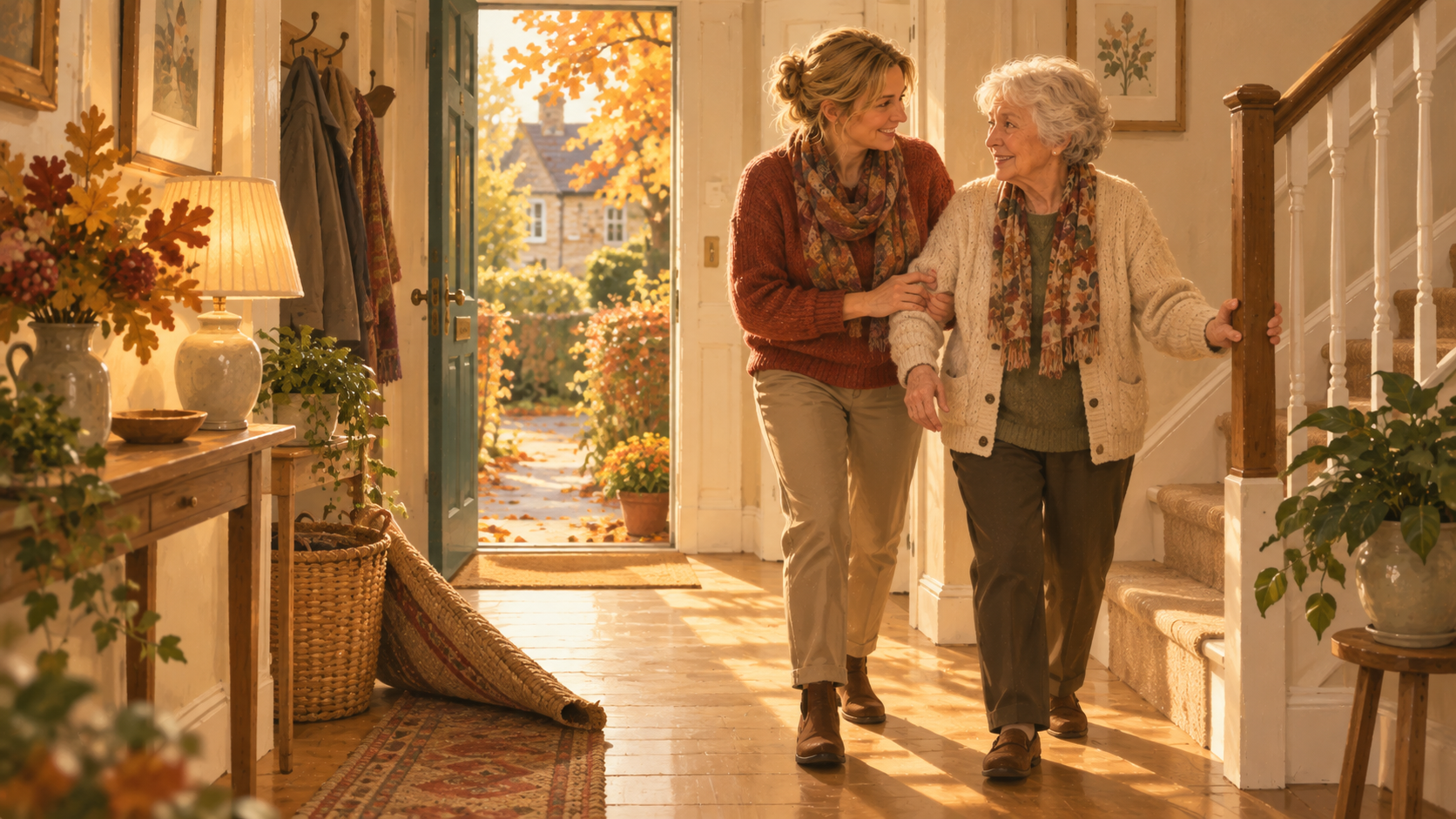
Around one in three people over 65 have a fall each year, and around half of those over 80. Falls are the most common reason older people are admitted to hospital with an injury, and a fall is very often the moment a family goes from managing to not managing.
The useful thing to know is that falls are not an inevitable part of getting older. A good proportion of them are preventable, and the things that work are mostly unglamorous.
The two that matter most
If you do nothing else, do these.
Strength and balance exercise. This is the single most effective intervention there is, and it is consistently the one families skip because it sounds too mild to matter. The evidence is strong: programmes built around balance and functional exercise, done regularly, cut the rate of falls substantially.
It does not mean the gym. It means standing up from a chair without using hands, standing on one leg while holding the worktop, heel-to-toe walking along the hallway. A few minutes most days. Most councils and leisure centres run strength and balance classes for older people, often free or heavily subsidised, and the NHS publishes routines you can do at home.
The social side matters too. A class gets someone out of the house once a week, which does its own work.
A medication review. Taking five or more medicines is associated with a higher risk of falling. Some medications cause dizziness, drops in blood pressure on standing, or drowsiness, and the combination is often the problem rather than any single one.
Ask the GP or pharmacist for a structured medication review. It is free, people taking several medicines are a priority for one, and it is genuinely one of the highest-value hours you can arrange. Do not stop anything without advice.
Eyes and feet
Eyes. An annual sight test, free over 60. Worth knowing that varifocals can increase trip risk on stairs, because the lower part of the lens blurs the step. Some people do better with a separate pair for going out.
Feet. Foot pain, long toenails and poor footwear all affect balance. Podiatry is available on the NHS in some circumstances and privately for modest cost.
Shoes and slippers. Backless slippers are one of the most common contributors to falls at home. A proper pair with a fastening and a grip sole is a small purchase that does real work. Walking around in socks on hard floors is the other one.
The house
Most falls happen at home, on familiar ground, doing ordinary things.
Floors. Loose rugs, trailing flexes, clutter on the stairs. Rugs are the classic hazard and the classic argument, because people are attached to them. Non-slip underlay is a reasonable compromise.
Lighting. A lamp within reach of the bed, a light on the landing, and something that lights the route to the bathroom. Plug-in sensor lights cost very little and prevent a great many night-time falls.
Stairs. Two rails rather than one if the stairs are steep. Check the carpet is not lifting at the edges. Something to mark the top and bottom step helps if eyesight is poor.
Bathroom. Where a lot of serious falls happen. Grab rails by the bath and beside the toilet, a non-slip mat, and a shower seat or bath board if getting in and out is a struggle. An occupational therapy assessment through the council can get some of this provided or fitted, and our guide to home adaptations covers what is available.
Kitchen. Move everyday things to waist height. Standing on a chair to reach the top cupboard is how a lot of hip fractures start.
Outside. Level paths, working outside lights, grit down before the first frost rather than after.
The things people do not think of
Getting up too quickly. A drop in blood pressure on standing is a common cause of dizziness. Sitting on the edge of the bed for a minute before standing is a genuine intervention.
Not drinking enough. Dehydration causes dizziness and confusion. Many older people deliberately drink less to avoid trips to the toilet, which trades one risk for a worse one.
Alcohol. Even a modest amount affects balance more at 80 than at 50, particularly alongside medication.
Eating properly. Muscle loss accelerates when protein intake drops, and weak legs are the root of a lot of falls.
A cold house. Cold reduces dexterity and slows reactions.
Rushing to the phone or the door. Worth having a phone in the usual sitting place, and worth agreeing that the doorbell can go unanswered.
If they have already fallen
A previous fall is the strongest predictor of another one, so the response to a first fall matters a great deal. If a fall has just happened and you are working out what to do this week, our guide to what to do when a parent suddenly needs help covers the first few days.
Tell the GP, even if nobody was hurt. This is the step families most often skip. A fall should trigger a falls assessment, which looks at strength, balance, medication, blood pressure, eyesight and the home environment. It is exactly what the current NICE guidance recommends and it is frequently not offered unless someone asks.
Ask about the falls prevention service. Most areas have one. Referral is usually through the GP.
Take the fear seriously. After a fall many people restrict what they do, which weakens them further and makes the next fall more likely. That spiral does more long-term damage than the original fall, and we have written about how small setbacks affect independence separately.
Work out how they would get help. If someone falls and cannot get up, how long before anyone knows? A pendant alarm, a smartwatch with fall detection, or simply a daily check-in call. Long waits on the floor cause serious complications.
If the fall led to a hospital stay, the weeks after discharge are the riskiest period of all, and our piece on support after hospital discharge is worth reading before they come home.
When to get medical help
999 for a suspected broken bone, a head injury, if they cannot get up, if they are on blood thinners and have hit their head, or if they are confused or drowsy after a fall.
GP the same day for a fall with no obvious injury but new confusion, a fall with dizziness or blackout, or any second fall in a short period.
GP within a few days for any fall at all, so it goes on the record and triggers an assessment.
A few questions families often ask
Is my mum just going to keep falling?
Not necessarily. Falls have causes, and most of those causes can be addressed. Assuming it is inevitable is the mistake.
She has fallen but insists she is fine.
Very common, usually because she knows what admitting it might lead to. Mention it to the GP anyway.
Will an alarm help?
It does not prevent a fall, but it dramatically reduces the harm from a long wait on the floor. Easier to introduce before a fall than after. Worth knowing that personal alarms can often be bought without VAT.
Can we get grab rails fitted for free?
Often, yes. Ask the council for an occupational therapy assessment. Minor adaptations are frequently provided at no cost.
Is she safe living alone?
A question about the whole picture rather than falls alone. Regular support at home is often what makes it workable, and our guide to how much help your parent actually needs is a good place to start.
Where support at home fits
A great many of the families we speak to make contact after a fall. Someone coming in regularly helps in ways that are easy to underestimate: noticing the hazard nobody spotted, making sure meals and fluids happen, prompting the exercises, and being there for the parts of the day when someone is least steady. Even a few hours a week can make a real difference.
If you are thinking about it, call 01225 63 77 19, request a callback, or read how Gladys works first.
